Welcome to the foundational post of ResonQ. Before we dive into the complexities of quantum computing and error correction, we must define the phenomenon that gives this project its name: Quantum Resonance.
In classical physics, resonance occurs when a system is driven at its natural frequency, causing large amplitudes of oscillation (think of a child on a swing). Quantum Resonance is a similar but far more subtle concept, operating at the subatomic level.
[Defining the Quantum Harmonic Oscillator]
At the core of many quantum systems, including the qubits we are trying to build, is the conceptual quantum harmonic oscillator. This is the quantum version of a vibrating spring.
[The Essence of Resonance]
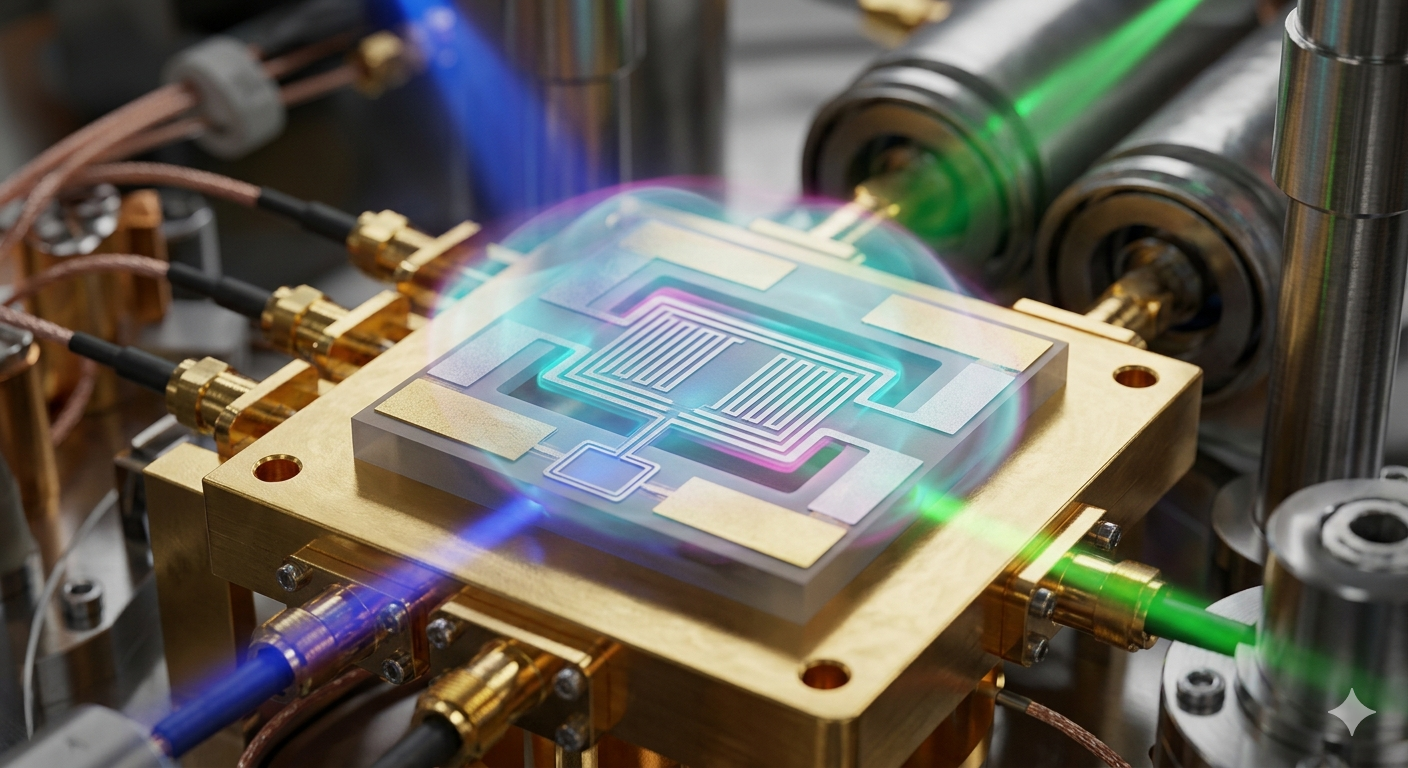
When two quantum systems, or a quantum system and an external driving force (like a microwave pulse), possess energy levels that precisely match (are 'resonant'), energy transfer occurs with maximum efficiency.
This synchronization is fundamental for controlling qubits:
- Qubit Operations: We use precisely tuned microwave pulses resonant with the qubit's energy transition to flip its state.
- Quantum Coupling: Two qubits can be made to interact (entangle) when their energy levels are brought into resonance, allowing them to 'talk' to each other.
- Quantum Sensing: Devices can be built that are highly sensitive to external forces (magnetic fields, gravitational waves) that shift a quantum system slightly off-resonance.
[Why Resonance Matters to ResonQ]
If decoherence is the noise that destroys quantum information, resonance is the rhythm that allows us to write it, read it, and—crucially—correct it. In future posts, we will explore how Quantum Error Correction (QEC) uses carefully engineered resonance conditions within topological codes to isolate and repair errors.
Resonance is the bridge between chaotic quantum behavior and controlled computing logic. At ResonQ, we focus on mastering that rhythm.